
Justice and Mental Health
For many survivors, feelings of justice and mental health can be heavily linked. Where the perpetrator is known, they might feel unable to go to the police. They might be concerned that their families and friends will not believe them. Yet at the same time, it can feel difficult knowing that a perpetrator continues to live largely unaffected by their actions. For those who were attacked by a stranger, they might feel unsafe going out, second-guess what they wear, where they go and what they do.
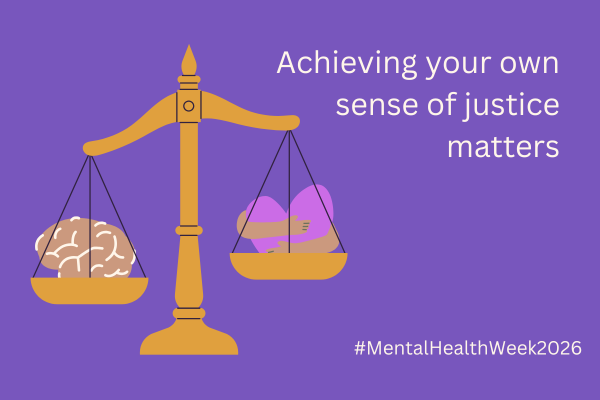
This Mental Health Week, we think it’s important to understand that justice isn’t always a courtroom or a guilty verdict. It is also healing at your own pace, having control of your decisions, getting a good night’s sleep. Here we look at a few ways we can achieve a sense of justice, beyond what happens in court.
Healing at your own pace
When somebody has experienced sexual violence, the impact can be devastating. At the same time the pressure to be okay and move on can be exhausting. Where the abuser was a close friend or family member, the feelings of betrayal and distrust can last a long time. For many this can feel like grief; a letting go of the future and the good things planned.
Allowing ourselves to heal at our own pace is vital. This is where support services like Notts SVSS can help. Counselling and therapeutic services can help work through different emotions and how to look after yourself away from the space.
It is helpful to remember that healing isn’t always linear. It can be surprising when feelings of sadness and grief pop-up. Not being able to share an achievement can bring up difficult feelings. Justice in these situations is putting the blame where it belongs. It is knowing that you are okay as you are, that it was not your fault and the shame is not yours.
The helpline service and drop-in appointments are also there to help provide support in more immediate situations or when things feel particularly tough.
Making your own decisions
For people who experience sexual violence in relationships, making your own decisions can feel like justice. These might be simple decisions like what to make for dinner, through to looking for a job, going out on a date or trying something new. Choosing to learn new skills or wallpaper for a room can be real reasons to celebrate.
For Alice, it was changing a broken chain on her teenager’s bike. ‘When I came out of refuge, there were a lot of firsts; taking on a tenancy, getting school spaces, balancing being a single-parent with a job. Making these decisions on my own felt relentless and exhausting. One thing I really remember was changing the broken chain on my teenager’s bike. I had no idea how to do this, but the cost of a repair was too much.
‘So I chose to learn how to do it myself by watching videos on YouTube. I bought the chain, watched the video with my son and together we swapped the chain. We both learnt a skill, but I also learnt that I could depend on myself to be resourceful too.
‘It was a small thing, but it was an important thing.’
Going Out
We all know the difference between going out (to the shop) and ‘going out out.’ With so many myths blaming survivors for what happened (what they were wearing, why they were drinking or why didn’t they fight them off…’) going out for an evening can feel difficult.
Justice can look like arranging to go out for a drink or a meal, trying a new activity, or going to a new place for a first time. It is also knowing that we have the freedom and capacity to make those decisions.
There are lots of things you can do to help with these first steps, researching a place you are going to, making a fall-back plan or doing something with a trusted friend. Anything you do, is a chance to grow and redefine yourself, away from the abuse.
Self-care
‘Caring for myself is not self-indulgence. It is self-preservation and that is an act of political warfare,’ Audre Lorde. Many will have heard this quote or others around the need for self-care. But justice and self-care have strong links, because it is an active way of saying ‘I deserve better.’
Self-care doesn’t need to be expensive. It is not about buying the most expensive moisturiser or taking out a membership at an exclusive gym.
Self-care, at its most basic expression is choosing to look after ourselves on a regular basis, because this is what we deserve. This can be choosing a healthy meal, having a walk through the park or some down-time with some candles and music.
Crucially, it can also be choosing not to do stuff. For those who identify as people pleasers or have been told you need to do certain things to be valid, it is helpful to remember that ‘No’ is a complete sentence.
Whatever self-care feels like to you, do it. Because each time you are choosing this, you are reaffirming your importance to yourself and to the world.
Setting boundaries
Anybody who has experienced sexual violence, will know what it is like to have someone cross their boundaries. Where this as part of a pattern of abuse, such as coercive control, it might be even more difficult to describe where those boundaries are. For people who were drunk or vulnerable or in a position where they didn’t feel able to say no, the feeling of somehow being to blame can feel intense.
We are all entitled to set our boundaries and to decide what they are. This includes survivors of sexual violence and abuse. It is also okay to alter boundaries and to have different boundaries for different people. For example, in a new relationship, you might have very high boundaries, but these may change over time.
There are also different ways of setting boundaries, whether they are physical, situational, mental or digital. Blocking people from your social media might be a good boundary to set, as might not allowing somebody to contact you during work hours, come to your house or meet your family.
Our helpline staff can help you discuss boundaries and how you might set them. For survivors going through the criminal justice system, our ISVAs can also provide support.
Knowing the Truth
There is a lot to be said for knowing the truth. It can be very difficult when survivors are met with disbelief or denial. You might have been asked why you didn’t report it to the police or why it took so long to say anything.
At Notts SVSS we listen, we believe and we support. We listen to survivors and we believe the things they tell us. We know that survivors have no reason or benefit to make up stories about the things that happened to them. Justice and asking for support does not depend on a court case or a guilty verdict.
Knowing the truth, despite what others may think is a real strength. Survivors are the only people who can choose what justice feels like and how you want to move on after abuse.