The Need for Trans-inclusive Spaces
As a service which provides support to all survivors of sexual violence, aged 18+, Notts SVSS provides trans inclusive and gender-aware services. With the Supreme Court ruling and the new EHRC guidance in place, we have worked hard to ensure that all survivors are able to access our service. Our Trans-Inclusion Policy and policies related to gendered support are can be found on the Useful Policies section of our website.
This Transgender Awareness Week, we have invited Nottingham Pastel Project to write a guest blog for us on the need for openly-inclusive trans spaces…
The Need for Trans-Inclusive Spaces and the Barriers to Access
With the recent updates to the EHRC and guidance on single-sex spaces removing trans people from crucial support services, there is a lot to understand in terms of the impact and the statistics surrounding this. Nottingham Pastel Project is a grassroots trans rights activism group in Nottingham and beyond. Our mission is to enable trans people to simply exist, in peace and with respect in all parts of life: socially, professionally and in health-care settings.
Barriers to Access
The recent changes to guidance have caused immense confusion for single sex service providers about the legality and potential for consequence should they ignore the guidance. Trans people have been using toilets, changing rooms and services that align with their gender identity for years without issue (TransActual UK). The trans community makes up less than 1% of the general population and there is little to no documented negative impact of shared spaces with both transgender and cisgender users.
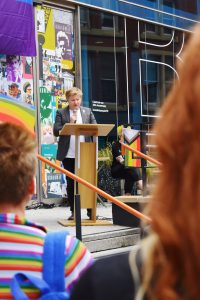
Nottingham Pastel Project talking at the launch of the Rainbow Quarter
However, we hear constant stories of trans and non-binary individuals feeling anxious to access toilets in bars, pubs and public spaces for fear of being challenged, intimidated and embarrassed. As well as the use of regularly accessed public and social spaces, barriers to accessing life-saving health services have increased in recent years. A sexual assault or coming out of a domestic violence situation is devastating enough without having to do masses of personal research to avoid trying to access a service and be denied. Trans people are at higher risk of not accessing support services for fear of rejection, increased harm due to untrained staff and the impact of the stress caused.
There is always discussion about third spaces or gender-neutral spaces as well as single-sex spaces. Many trans people who may not be ‘out’ have said that suddenly being required to use a gender-neutral toilet at work, would force them to ‘out’ themselves to colleagues and peers. Many smaller bars and pubs do not have the space or infrastructure to build or include a sudden third bathroom option in wake of the guidance. This suggestion is heavily flawed and treats trans people as something to be kept separate and singled out – adding further risk of verbal harassment, unwanted attention or worse.
Trans people are at higher risk of not accessing support services for fear of rejection, increased harm due to untrained staff and the impact of the stress caused.
How can services be trans inclusive
Services, particularly health services, hold a great responsibility to be sensitive and inclusive. Thorough and updated staff training is one of the most effective ways to ensure that a trans person who seeks to access your services is met with dignity, respect and understanding. Training around pronouns, appropriate language and knowledge of safeguarding when it comes to confidentiality are crucial in this setting. Ensuring that a trans person’s preferred pronouns are always used and that no record keeping uses deadnames or incorrect pronouns increases the feeling of safety for the service user. When it comes to sexual assault support services such as Notts SVSS, it is important to understand the nuance and relevance of the survivor being a trans individual. The Survivors Network held a research study in 2021 for trans and non-binary individuals and the main feedback was:
- Constant staff training and improvements of processes were needed – created in consultation with trans and non-binary people
- Partnerships with LGBTQ+ organisations should stay up to date, receiving training from trans people themselves
- Diverse work forces enable trans service users can see themselves within the organisation they are seeking help from – meaning they are not always being treated by a cisgendered practitioner
In Nottingham, we are incredibly fortunate to have long-running inclusive services that continue to support the trans community. There are nearly 300 venues publicly showing allyship through the ‘Your Spaces Too’ campaign.
Hope in Nottingham
In Nottingham, we are incredibly fortunate to have long-running inclusive services that continue to support the trans community. This is really important where trans and gender non-conforming individuals face the constant closure of services and reduction in funding for inclusive spaces, creating more barriers to access. However, in Nottingham/shire we have services that have continued to prove their solidarity with the trans community, some even specialising in LGBTQ+ support. Notts SVSS’s commitment to trans-inclusion and delivering services for all ensures they remain a safe place for trans individuals to seek support. Equation provides the area’s specialist domestic abuse for LGBTQ+ people and are trans-inclusive. You can find out more about their exclusive LGBTQ+ helpline, support and specialist trained team here. Nottingham Women’s Centre has always been inclusive of trans women and continue to fight to do so.
As well as health and support services, Nottingham Pastel Project launched the “Your Spaces Too” campaign in early 2025. This campaign encourages local venues to apply to our scheme to publicly display their allyship with trans customers and clients. Applying requires the venue to complete a questionnaire based around situations that could arise within the venue, especially regarding transphobia and querying of bathroom usage. If their answers sufficiently display inclusive language understanding and a commitment to protecting trans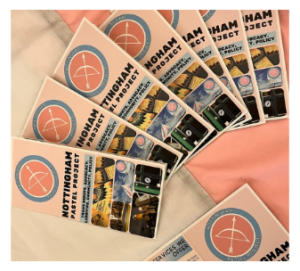 and non-binary users, then they are awarded a window sticker to display.
There are now almost 300 venues signed up around Nottingham and beyond including bars, restaurants, tattoo shops, small businesses and more. We hope that trans people in Nottingham can feel a sense of reassurance before entering a venue if one of our YS2 stickers is on display. It also enables them to contact us and report any potential instances where a sticker needs to be revoked. This is a scheme constantly under review and we hope that it continues to grow. If you have a business and would like to enquire about the scheme, please head to our Instagram @notts_pastel_project to apply.
Call to Action
If you’re an employer or a business and want to find out how to show solidarity with trans employees and customers, there are lots of useful things you can do:
- Create a Trans Inclusion Policy for staff, customers or service users
- Ensure that when you’re writing policies around staff, ensure you also consider the needs of LGBTQ+ members of your team
- Educate yourself on trans issues, by looking up local helplines (detailed below) or contacting trades unions or organisations working in the area, such as Gendered Intelligence and Trans Actual
- Arrange for training for your staff team
- Join Nottingham Pastel Project‘s Your Space Too scheme to show your support.
If you are trans, non-binary or gender non-conforming, living in Nottingham/shire, there are lots of places you can get information and support:
For support around Domestic or Sexual Violence:
- Equation – support for LGBTQ+ survivors of domestic abuse
- Notts SVSS – for LGBTQ+ survivors of sexual violence